How do I know if my parking lot needs asphalt patching?
Your parking lot needs asphalt patching when you spot potholes, alligator cracking (a web of interconnected cracks that looks like reptile skin), edge cracking, or depressions where water pools after rain. Any one of these means the pavement surface or base layer is failing. Catching them before Ohio's first hard freeze prevents damage that costs far more to fix in spring.
How long can I wait before patching cracks in my Parma parking lot?
You should not wait past fall if cracks are already visible. Parma averages over 60 inches of snowfall per year, and water that seeps into a crack, freezes, and expands can turn a hairline crack into a two-foot pothole in a single winter. Most patching jobs take less than a day — delaying them almost always means paying for a much larger repair or full resurfacing the following season.
Is asphalt patching a permanent fix or just a temporary repair?
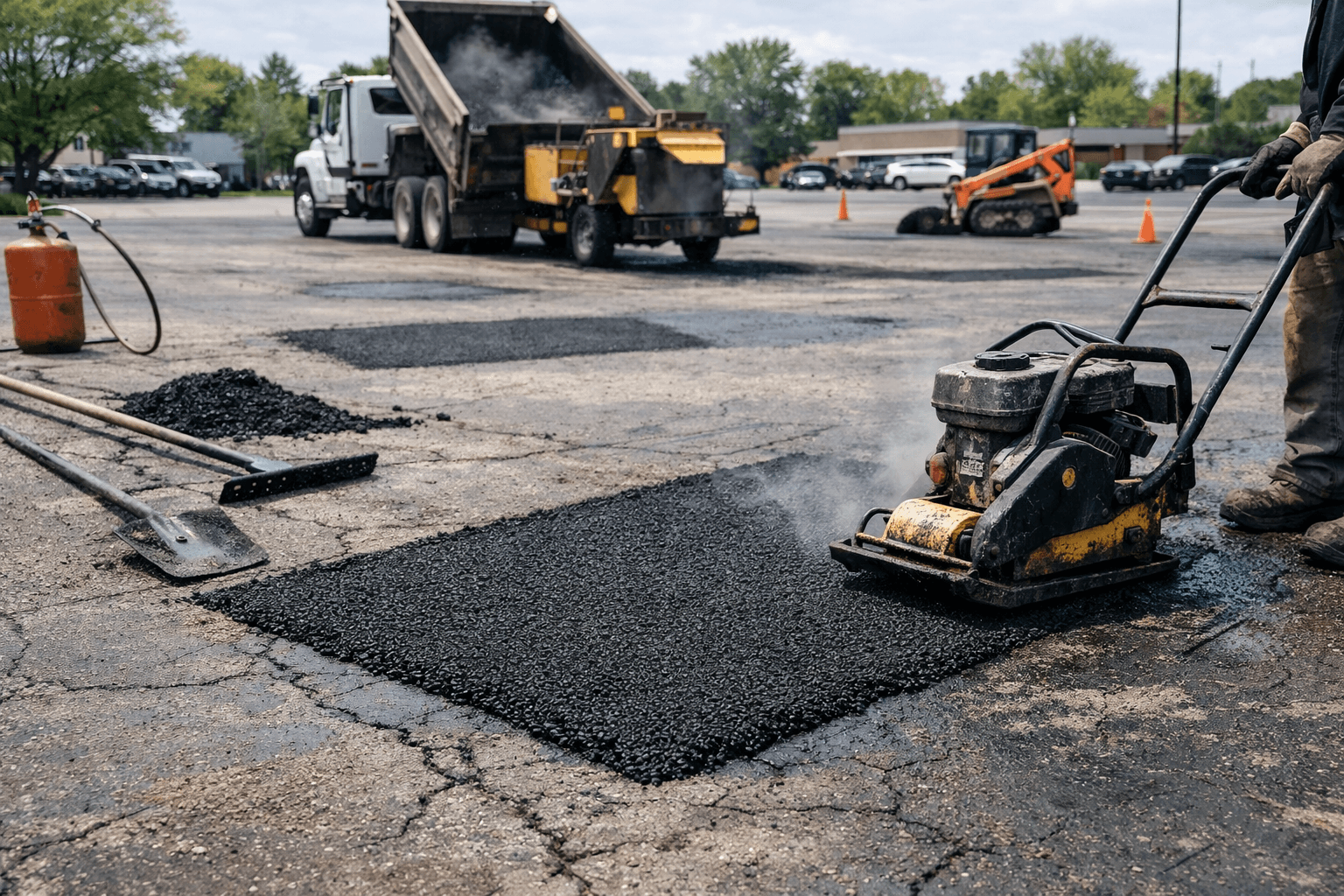
Done correctly — with proper base prep and hot-mix asphalt compacted in lifts — a patch holds for many years and bonds structurally with the surrounding pavement. A cold-patch thrown in to get through the winter is temporary. The difference comes down to base work: if the underlying aggregate is failing, no surface patch will last. A crew that diagnoses the cause before they pave is the one you want.
Below, we walk through the specific warning signs Parma property owners and managers should watch for, explain what each symptom means structurally, and lay out when patching is enough versus when a bigger fix is warranted. If you're heading into a Cuyahoga County winter with unaddressed pavement damage, this is the guide to read first.
The Warning Signs Your Lot Is Telling You Something
Asphalt doesn't fail overnight. It gives you signals — usually months before the surface becomes a liability. Learning to read those signals is the difference between a targeted patch job and a full lot teardown.
Alligator Cracking — The Most Urgent Signal
Alligator cracking is the single most urgent sign that your pavement base is failing. It gets its name from the interconnected pattern of cracks that looks exactly like reptile scales. When you see it, the problem isn't just at the surface — the base layer beneath has lost its load-bearing capacity, usually from water infiltration, heavy traffic, or both.
A simple sealcoat won't fix alligator cracking. You need the deteriorated section removed, the base regraded and compacted, and new hot-mix asphalt placed in proper lifts. Ignore it heading into winter and every freeze-thaw cycle makes the affected area larger. Learn more about the right repair approach on our Patching Repairs service page.
Potholes — Damage You Can See and Feel
Potholes form when alligator cracking goes unaddressed and traffic pressure punches through the weakened surface. They're a liability issue for Parma property owners — trip-and-fall claims and vehicle damage complaints follow quickly. A pothole also collects water, which accelerates the damage radius with every freeze cycle.
Small potholes caught early can be patched efficiently. Potholes left until spring — especially after a Cuyahoga County winter — are often twice the size they were in October. Act before the ground freezes.
Longitudinal and Transverse Cracking
These are the long straight cracks that run parallel to (longitudinal) or across (transverse) the direction of paving. They're usually early-stage thermal or shrinkage cracking — the asphalt contracting and expanding with temperature swings. On their own, they're not a base failure. But unsealed, they let water in.
Crack filling is the right response at this stage. It's fast, relatively straightforward, and buys years of pavement life if done before winter. Wait until spring and you may be looking at full-depth patching instead.
Edge Cracking and Raveling Along Lot Perimeters
Edge cracking runs along the outer margin of the pavement, usually where the asphalt meets a curb, grass, or unpaved shoulder. It's caused by lateral support loss — the edge has nothing holding it, so it crumbles outward under vehicle weight. Raveling (the surface becoming loose and granular) often shows up alongside it.
These areas catch water from both the pavement surface and the adjacent grade, making them especially vulnerable in Parma's wet springs and hard winters. Edge patching and proper grading of the shoulder area are the standard fix.
Depressions and Low Spots
If you see standing water on your lot after a rain that doesn't drain within an hour or two, you have a drainage problem — and likely a settling or compaction failure underneath. Depressions that hold water are actively undermining your pavement base every time it rains.
The fix depends on depth. Shallow depressions may only need surface leveling. Deeper settlement usually means removing the section, correcting the subgrade, and repaving. Either way, a site walk is the only way to tell for certain — which is exactly why we don't quote off a phone call.
Quick Damage Assessment: What You're Seeing vs. What It Means
| What You See | Likely Cause | What Happens If You Wait |
|---|---|---|
| Alligator cracking | Base failure, water infiltration | Potholes form; repair area expands |
| Potholes | Advanced base failure | Liability risk; doubles in size over winter |
| Linear cracks | Thermal shrinkage | Water infiltrates; base softens |
| Edge cracking / raveling | Lateral support loss | Perimeter crumbles; drainage worsens |
| Standing water / depressions | Settlement, poor compaction | Accelerated base erosion; section fails |
- Alligator cracking: base failure from water — leads to potholes if untreated
- Potholes: advanced surface failure — liability risk that grows every freeze cycle
- Linear cracks: thermal shrinkage — manageable now, costly later
- Edge cracking: lateral support loss — worsens with every wet season
- Standing water: drainage and compaction failure — actively undermining the base
When Is Patching Enough — and When Do You Need More?
Patching works well when damage is isolated and the surrounding pavement is structurally sound. If you're dealing with a pothole in one corner of an otherwise solid lot, patching is the right call. If cracking covers more than 30–35% of your surface, or if the base is compromised under a wide area, Asphalt Resurfacing is a more cost-effective long-term answer than patching each section piecemeal.
The honest answer requires a site walk. Every lot is different — age, traffic load, drainage, existing base depth, and the quality of prior work all affect the right repair approach. According to the Federal Highway Administration's Pavement Preservation Guide, early intervention on pavement distress consistently delivers better life-cycle outcomes than deferred maintenance. Put simply: spend a little now or spend a lot later.
Why Ohio's Freeze-Thaw Cycle Makes Timing Everything
Parma sits in a climate zone where freeze-thaw cycles can occur 40 or more times per winter season. Each cycle pushes water into existing cracks, freezes it, expands the crack, and leaves more room for the next cycle to do the same. Ohio State University Extension notes that repeated freeze-thaw action is one of the primary drivers of pavement deterioration in northern Ohio.
The practical window for quality asphalt patching in the Parma area runs from late spring through mid-October. Asphalt requires ground and ambient temperatures above 50°F to bond properly. Jobs rushed in cold weather don't compact correctly and won't last. If damage is visible now, the time to address it is before the season closes — not after the snow melts.
Pre-Winter Lot Inspection Checklist for Parma Property Owners
- Walk the full perimeter — edge cracking is easy to miss from a car
- Check all high-traffic lanes and entry points for alligator cracking
- Look for depressions in drive lanes and near catch basins
- Scan for potholes or soft spots after a rain event
- Note any areas where the surface appears faded, brittle, or raveling
- Check drainage — does water clear within an hour of a moderate rain?
- Document with photos and share them when you call for an estimate
If your walk turns up more than one or two of these issues, call before the end of the paving season. Swartz Paving has been doing commercial and industrial paving in Ohio since 2012, and the same crew that walks your lot runs the equipment — no subcontractors, no handoffs. We can often phase repair work around a business that needs to stay open. Visit our Parma OH service area page for more on what we cover in Cuyahoga County.
If you're evaluating whether to patch or invest in a longer-term pavement plan, our How To Choose An Asphalt Paving Contractor guide walks through exactly what to ask and what to watch for when vetting a crew.
Frequently Asked Questions
Can asphalt be patched in winter in Parma, OH?
Cold-patch asphalt can be placed in winter as a temporary fix to keep a pothole safe until proper repairs can be made in warmer weather. However, permanent hot-mix patching requires ambient and surface temperatures above 50°F to compact and bond correctly. If you have active potholes in winter, a cold patch is appropriate as a stop-gap — plan the full repair for early spring when temperatures allow quality work.
How long does a properly done asphalt patch last?
A patch done with proper base preparation and hot-mix asphalt compacted in lifts can last 8–15 years or more in normal commercial conditions. The key variable is base work — if the underlying aggregate layer isn't addressed, even a good surface patch will fail prematurely. Patching applied over a compromised base is a short-term fix regardless of the mix quality used on top.
What's the difference between crack filling and patching?
Crack filling seals individual linear cracks to keep water from penetrating the base — it's appropriate when the surrounding asphalt is still structurally sound. Patching removes and replaces a section of pavement, usually because the base beneath it has failed. Crack filling is a maintenance-level task; patching is a repair. Both are important, and catching damage at the crack-filling stage is always less involved than waiting until patching is required.
Will patching a parking lot disrupt my tenants or customers?
In most cases, no — at least not significantly. Swartz Paving can phase repair work to keep portions of a lot open while sections are being repaired. Typical patch jobs on commercial lots are completed in a matter of hours per section, and asphalt is generally drivable within a few hours of placement. We plan the sequence with your operations in mind before we start, not as an afterthought.
Do I need a full resurfacing instead of patching?
If isolated sections are failing but the majority of your pavement is structurally sound, patching is the right approach. If alligator cracking or base failure covers more than roughly a third of the lot, full Asphalt Resurfacing usually delivers better long-term value than repeated patching. The only accurate way to determine which is right for your specific lot is a site walk and honest assessment — which is exactly how Swartz Paving starts every job.
Ready to find out what your Parma parking lot actually needs before winter sets in? Swartz Paving provides free, itemized written estimates — we walk your site first and put it in writing before any work begins. We don't quote off a phone call. Call us at (419) 528-9536 or request a free estimate online and we'll follow up with next steps. Availability fills up as the season closes, so the sooner you reach out, the better.
Ready to Talk Through Your Pavement Project?
Request a free estimate and we’ll follow up with next steps.