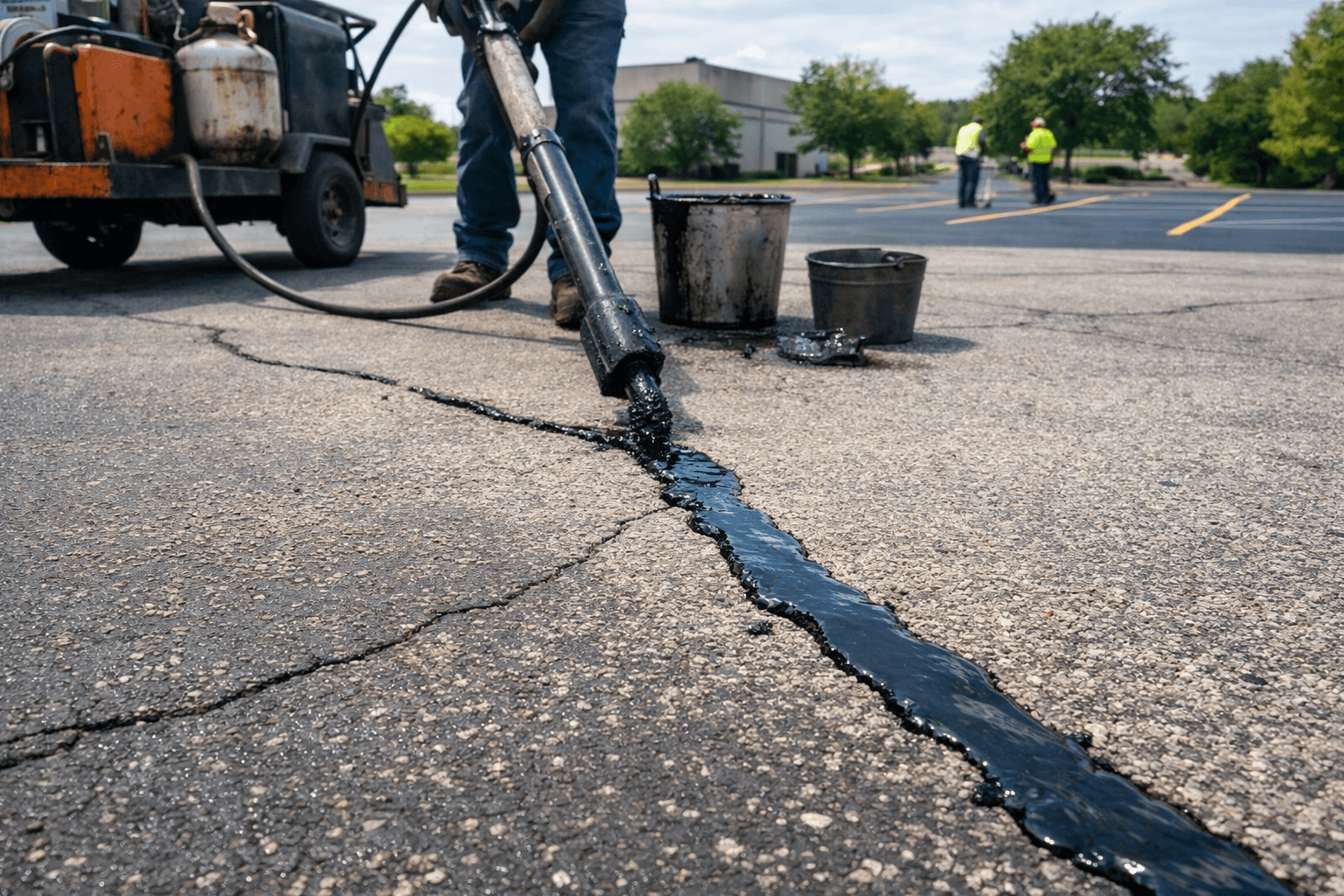
Does crack filling actually stop pavement from getting worse?
Yes — crack filling works by sealing out water before it reaches the base layer beneath your asphalt. Once water gets into a crack, it softens the sub-base and, in Ohio winters, freezes and expands that crack wider with every cycle. Sealing cracks early keeps water out, keeps the base intact, and extends the life of your pavement by years at a fraction of what full repaving costs.
When is the right time to fill cracks in Elyria, Ohio?
Late summer through mid-fall is the best window — pavement is still warm enough for sealant to bond properly, and you're getting ahead of the first hard freeze. In Elyria, that first freeze can arrive in October. Any crack wider than a hairline that isn't sealed before freeze-thaw cycles begin will be measurably larger by spring. The sooner you address it, the less damage you're stopping.
How long does crack filling last on a commercial parking lot?
A properly applied hot-pour crack filler on a commercial lot typically holds for three to five years under normal traffic, according to industry estimates. Longevity depends on the width and depth of the crack, how well the crack is cleaned before filling, and the quality of the material used. Skipping prep work — blowing out debris and drying the crack — is the most common reason fills fail early.
The rest of this piece walks through exactly why Elyria property owners need to act before winter, what the crack filling process actually involves, and how to tell whether your pavement needs filling now or is already past that point.
If you're looking at cracks in your parking lot right now, every week you wait before the first freeze is a week of free damage. Ohio's freeze-thaw cycle doesn't care about your budget or your schedule — it just works on whatever opening you've left it.
Why Ohio's Freeze-Thaw Cycle Is Harder on Asphalt Than Almost Anywhere
Elyria sits in a climate zone that routinely cycles above and below freezing dozens of times each winter. According to NOAA's Cleveland forecast office, the Lake Erie region averages more than 100 freeze-thaw cycles per year — significantly more than inland areas of the country.
Water expands about 9% when it freezes. That doesn't sound like much until you picture it pushing outward inside a crack in your asphalt, every single night the temperature drops and every morning it rises. A hairline crack becomes a quarter-inch crack. A quarter-inch crack becomes a half-inch gap. A half-inch gap starts admitting enough water to erode the compacted aggregate base underneath.
Once the base is compromised, you're no longer looking at crack filling. You're looking at base repair, patching, or full-depth replacement — all of which cost significantly more. Filling cracks before winter is the single highest-return maintenance action you can take on an asphalt surface.
What Does the Crack Filling Process Actually Involve?
This is where shortcuts show up — and where you can tell whether a contractor knows what they're doing.
A proper crack filling job on a commercial or industrial surface follows a clear sequence:
- Crack cleaning: Compressed air or a mechanical router removes loose debris, vegetation, and old filler from the crack. A wet or dirty crack will not bond properly.
- Drying: The crack must be dry before any sealant is applied. Even residual moisture causes adhesion failure.
- Hot-pour application: Commercial-grade hot-pour rubberized crack filler is melted and applied into the crack using a pour pot or applicator wand. Hot-pour material stays flexible across temperature swings, which matters enormously in Ohio winters.
- Overfill and squeegee: A slight overfill with a squeegee band on top creates a cap that sheds water rather than pooling it in the filled crack.
- Cure time: Traffic typically stays off the filled cracks for 20–40 minutes depending on temperature.
Cold-pour crack filler — the kind you find in a hardware store jug — is not a substitute for commercial hot-pour material. It's softer, doesn't bond as well, and degrades faster under traffic. For a residential driveway, it's a passable temporary fix. For a commercial parking lot in Elyria taking daily vehicle loads through an Ohio winter, it won't last.
Our Crack Filling service uses hot-pour rubberized sealant on every commercial job. The crew that shows up to do the work is the same crew that walked your site and wrote the estimate — no subcontractors, no handoffs.
Crack Filling vs. Waiting Until Spring: What You're Actually Choosing
| Factor | Fill Before Winter | Wait Until Spring |
|---|---|---|
| Crack width by spring | Stays sealed and stable | Likely wider — may need routing or patching |
| Base layer condition | Protected from water infiltration | At risk of softening and erosion |
| Repair scope next year | Routine maintenance | Possible patching or resurfacing |
| Pavement lifespan | Extended by years | Shortened by repeated freeze-thaw damage |
- Crack width: Sealed before winter stays stable — waiting means wider cracks by spring.
- Base layer: Sealed cracks protect it — open cracks let water in all winter.
- Next year's repair scope: Filling now is maintenance — skipping it risks patching or resurfacing.
- Pavement lifespan: Early sealing extends it — repeated freeze-thaw damage shortens it.
How Do You Know If Your Pavement Needs Crack Filling or Something More?
Not every damaged surface is a crack filling job. Here's how to read what you're looking at:
- Hairline to ½-inch cracks: Good candidates for crack filling. Clean, apply hot-pour filler, done.
- Cracks wider than ½ inch or with crumbled edges: May need routing first, or patching if the base has shifted.
- Alligator cracking (interconnected cracks forming a web): This indicates base failure. Crack filling won't fix this — it needs Commercial Paving repair or full-depth patching.
- Potholes or sunken areas: Base repair before any surface work.
If you're not sure which category your lot falls into, a site walk is the only honest way to find out. We don't quote off a phone call — we walk the property, look at what's actually there, and give you a written, itemized estimate. That's been our approach since 2012.
Property managers across Elyria, OH deal with parking lots that have been patched, sealed, and re-patched without anyone actually assessing the base condition underneath. A proper assessment saves you from spending on surface work when the real problem is two inches down.
See our full range of Services — from crack filling and sealcoating through full parking lot construction — to get a picture of where crack filling fits in a complete maintenance plan.
Before Winter: Your Pavement Quick-Check
- Walk your lot and look for cracks wider than a credit card's thickness
- Check low spots where water pools — those areas freeze hardest
- Look for edges along curbs and expansion joints — high-failure zones
- Check any previous crack fills — if they're pulling away, they need refreshing
- Note any alligator cracking — that's a separate conversation from crack filling
If you walked your lot and found cracks, don't wait. Schedule a site visit now while the weather still allows proper bonding. Once we're into cold-weather territory, crack filling options narrow and results become less reliable. The Federal Highway Administration's pavement maintenance guidance consistently identifies crack sealing as the most cost-effective preventive treatment available for asphalt surfaces — and timing it correctly is half of what makes it work.
Frequently Asked Questions
Can crack filling be done while my parking lot is still open to traffic?
Yes, in most cases. Filled sections are typically ready for traffic within 20 to 40 minutes, depending on temperature. We can work in sections — filling one area while another stays open — so your business doesn't have to shut down during the job. We've been phasing work around operating businesses since 2012, and it's a routine part of how we schedule commercial jobs.
What's the difference between crack filling and sealcoating — do I need both?
They do different things. Crack filling seals specific openings in the asphalt surface to block water infiltration. Sealcoating applies a protective layer over the entire surface to slow oxidation and surface wear. If your lot has open cracks, those should be filled before sealcoating — otherwise you're sealing over a problem that will reopen. Many properties benefit from both, done in the right order.
How wide does a crack have to be before it needs professional attention?
Any crack wider than a hairline — roughly an eighth of an inch or more — is worth sealing before an Ohio winter. Hairline cracks are surface-level and often stable, but once a crack admits water, freeze-thaw cycles take over. A crack that's a quarter inch wide in October can easily double by spring. Erring on the side of early treatment is always the right call in this climate.
Does crack filling work on all types of commercial pavement?
Hot-pour crack filling works on standard asphalt pavement, which covers the majority of commercial parking lots and driveways in the Elyria area. It's not suitable for concrete joints or severely deteriorated asphalt where the surrounding surface has crumbled away. If the edges of the crack are soft or the surrounding pavement is failing, patching or a deeper repair is the right approach — and we'll tell you that plainly in the estimate rather than fill something that won't hold.
Will crack filling work if we already have cracks that survived one winter?
It depends on what the winter did to them. If the crack widened but the edges are still firm and the base beneath feels solid, hot-pour filling is still viable. If the edges have crumbled, the crack has branched into surrounding pavement, or you can see the base shifting, you've moved past filling and into patching territory. A site walk is the only way to make that call accurately — and we do those at no charge.
Ready to stop winter from turning a fixable crack into a repaving project? Call Swartz Paving, LLC at (419) 528-9536 or request a free estimate online. We'll walk your property, assess what's actually there, and give you a clear written estimate before any work begins. We don't quote off a phone call — because you deserve an honest look, not a number pulled from the air.
Ready to Talk Through Your Pavement Project?
Request a free estimate and we’ll follow up with next steps.