What is chip sealing and how does it work on Ohio roads and parking lots?
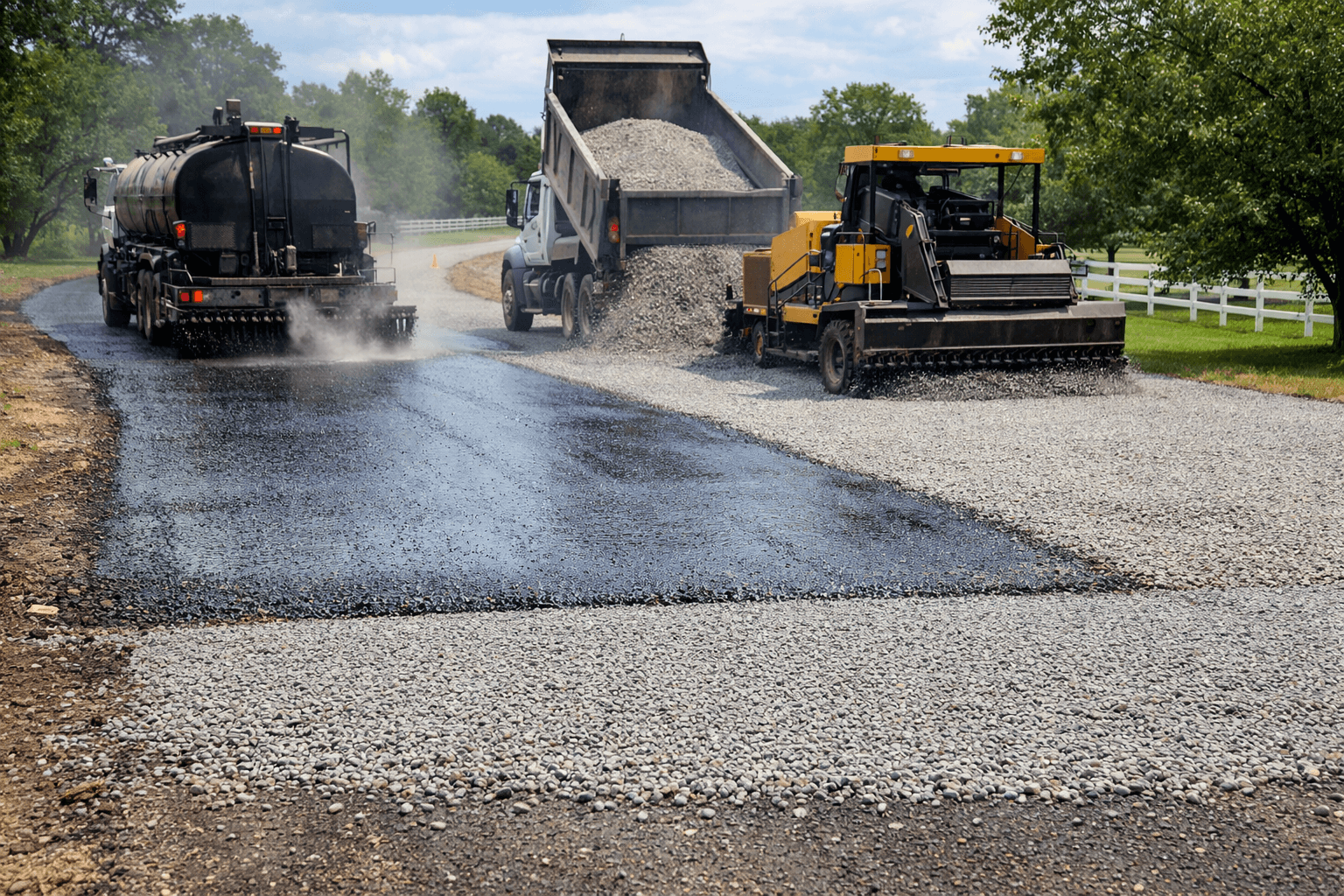
Chip sealing is a surface treatment where hot liquid asphalt binder is sprayed onto an existing pavement, then immediately covered with a layer of crushed stone aggregate. A roller presses the stone into the binder, and excess chips are swept away once cured. The result is a textured, weatherproof surface that binds to the existing pavement beneath it — extending its life at a fraction of the cost of full resurfacing.
How does chip sealing compare to sealcoating or full asphalt resurfacing in Ohio?
Chip sealing adds a structural layer of aggregate that sealcoating does not — it's a true surface treatment, not just a protective film. It costs significantly less than full resurfacing but does more than standard sealcoating alone. For Ohio properties with sound base structure but weathered or oxidized pavement, chip sealing often hits the sweet spot between doing too little and spending more than necessary.
How long does a chip seal surface last in Ohio's climate?
A properly applied chip seal surface typically lasts 7 to 10 years on low-to-moderate traffic pavements in Ohio, according to industry practice standards. Ohio's freeze-thaw cycles are hard on pavement, but chip sealing's aggregate layer actually handles thermal movement better than a thin sealcoat alone. The key is starting with a structurally sound base — chip sealing cannot correct deep base failures.
This guide covers the full picture: what chip sealing actually involves, where it performs best across Ohio, where it falls short, and how to decide if it's the right call for your property — whether you're managing a rural access road in Erie County or a light-traffic parking lot in Canton or Youngstown.
What Does the Chip Sealing Process Actually Look Like?
Understanding the steps helps you evaluate whether a contractor is doing it right — or cutting corners.
First, the existing surface is cleaned thoroughly. Any significant cracks or soft spots need to be addressed before the treatment goes down. Chip sealing applied over a failing base is money wasted — the aggregate will pop loose quickly and you'll be back to square one.
Next, a distributor truck applies hot liquid asphalt emulsion (the binder) at a controlled rate across the surface. Immediately after — and this timing matters — a chip spreader lays a single layer of clean, sized aggregate stone over the binder. The stone size is selected based on traffic load and surface type.
A pneumatic roller then seats the chips into the binder with multiple passes. After curing — typically 24 to 48 hours depending on temperature and humidity — a sweeper removes loose stone that didn't embed. That loose aggregate sweep is a step some operators skip or rush, and it matters: loose chips left on the surface become projectiles under traffic and reduce long-term adhesion.
At Swartz Paving, the same crew that walks your site and writes your estimate operates the equipment on job day. No subcontracted crews showing up with different standards — what you're told is what you get.
Where Chip Sealing Outperforms Other Surface Treatments in Ohio
Not every pavement situation calls for chip sealing — but when the conditions are right, it's one of the most durable and cost-efficient surface treatments available. Here's where it genuinely earns its place.
Low-to-Moderate Traffic Surfaces
Chip sealing is built for surfaces that see regular but not punishing traffic — access roads, service drives, secondary parking areas, rural commercial lots, and light industrial yards. It handles vehicle loads well in these conditions. High-speed or heavy truck routes are a different story, and we'll address that below.
Across Ohio, this makes chip sealing a practical fit for many commercial, municipal, and light industrial applications — from a church parking lot in Springfield to a service road at a storage facility in Lorain to a secondary entrance at a distribution yard in Toledo.
Pavement That's Oxidized But Structurally Sound
Ohio sun and temperature swings break down the surface oils in asphalt over time. Pavement turns gray, gets brittle, and starts to ravel at the surface — but the base underneath is still solid. That's the ideal candidate for chip sealing. You're restoring the surface, sealing out water, and extending the pavement's life without the cost of tearing out and replacing what's still doing its job below.
If your pavement looks rough on top but passes a basic inspection (no significant rutting, no alligator cracking, no soft spots), chip sealing is worth a serious look before you jump to full Commercial Paving or resurfacing.
Rural and Semi-Rural Ohio Properties
Chip sealing has a long track record in rural applications across Ohio — county roads, township drives, farm access routes, and rural commercial properties. The Ohio Department of Transportation has documented chip seal use extensively on lower-volume state and county routes precisely because it extends pavement life efficiently. If your property type matches that use pattern, the same logic applies to private paving.
Ohio's Freeze-Thaw Climate
Ohio averages more than 40 freeze-thaw cycles per year in northern regions — Lake Erie's influence makes Erie, Lorain, and Cuyahoga counties particularly tough on pavement. The aggregate in a chip seal surface gives pavement a protective layer that's more resistant to surface oxidation and minor moisture intrusion than a thin sealcoat alone. It's not a substitute for proper base prep, but it adds meaningful protection against the thermal cycling that cracks Ohio pavement faster than almost anything else.
At Swartz Paving, base work built for Ohio's climate isn't a marketing line — it's standard practice going back to 2012. Proper drainage, correct base thickness, and appropriate aggregate selection all factor into how a chip seal performs through a central Ohio winter.
Chip Sealing vs. Common Alternatives: When to Use Which
| Factor | Chip Sealing | Sealcoating Only | Full Resurfacing |
|---|---|---|---|
| Best pavement condition | Oxidized, surface-worn, structurally sound | Sound surface, minor oxidation | Structural damage, rutting, alligator cracking |
| Traffic load | Low to moderate | Any, as a protective coat | Any, including heavy commercial |
| Adds structural layer? | Yes — aggregate embeds into binder | No — thin film only | Yes — full new lift of asphalt |
| Expected service life | 7–10 years | 2–4 years per application | 15–25 years with maintenance |
| Ohio freeze-thaw performance | Strong — aggregate resists surface cracking | Moderate — surface only | Depends heavily on base prep |
| Finish texture | Rough/textured — good traction | Smooth, black finish | Smooth, like new asphalt |
- Pavement condition: Chip sealing fits oxidized-but-sound surfaces — sealcoating is lighter maintenance, resurfacing handles structural damage.
- Traffic load: Chip sealing handles low-to-moderate traffic well — heavy commercial routes need full resurfacing.
- Structural layer: Chip sealing adds one — sealcoating does not — full resurfacing adds the most.
- Service life: Chip sealing delivers 7–10 years — longer than sealcoating cycles, shorter than full asphalt replacement.
- Freeze-thaw performance: Chip sealing's aggregate layer resists Ohio's thermal cycling better than a thin sealcoat film.
- Surface finish: Chip seal is textured and rough — not ideal for high-image retail; better for utility and access surfaces.
Where Chip Sealing Falls Short — and What to Use Instead
A good contractor tells you when chip sealing is the wrong tool, not just when it's right. Here are the situations where you should look at other options.
High-Traffic Commercial Parking Lots
A busy retail parking lot in Parma or a high-turnover commercial property in Cincinnati isn't a good fit for chip sealing as the primary surface. Constant turning, stop-and-go traffic, and tight turning radii cause chip loss and surface degradation faster than on a straight-run access road. For those applications, full Parking Lot Construction or asphalt resurfacing gives you the smooth, durable surface that holds up and looks professional.
Pavement With Base Failures
If your pavement has alligator cracking (that web-like pattern of interconnected cracks), significant rutting, or spots that flex or sink under weight, the base is compromised. Chip sealing over a failed base is like painting over rot — it hides the problem briefly and then fails, often faster than doing nothing. Base repair or full reconstruction is the correct answer in these cases.
High-Image Retail or Office Properties
Chip seal's textured, aggregate surface isn't the finish you want in front of a professional office building or a customer-facing retail property in Dayton or Columbus. It reads as utilitarian, not polished. For those properties, smooth asphalt with fresh striping is the right call — it projects professionalism and handles the traffic pattern those properties generate. Ask about our Commercial Paving options if that's your situation.
Pavements Already Treated With Certain Sealers
Some coal-tar or oil-based sealers can interfere with binder adhesion on a chip seal application. If your lot has been sealed recently, or if there's buildup from multiple sealer applications over the years, a site inspection is essential before committing to chip sealing. This is one reason we walk every site before writing a word on an estimate.
Is Your Pavement a Good Chip Seal Candidate? Quick Self-Assessment
- Surface looks gray or weathered but feels firm underfoot — no soft or spongy areas
- Cracks are present but relatively narrow and not interconnected (alligator pattern)
- No significant rutting or deformation in wheel paths
- Traffic is light to moderate — primarily passenger vehicles and light trucks
- Surface is not highly visible from customer-facing areas where finish appearance is critical
- You want a multi-year extension of pavement life without full reconstruction investment
If most of those apply, chip sealing is worth a site inspection. Call (419) 528-9536 — we'll walk the property and give you a straight answer, in writing, before any commitment.
How Chip Sealing Fits Into a Long-Term Pavement Maintenance Plan
The properties that spend the least on pavement over a 20-year period are the ones that maintain it strategically — not the ones that ignore it until it fails and then pay for full reconstruction.
A typical pavement lifecycle for a commercial or light industrial property in Ohio looks something like this: new asphalt is installed with a properly prepared base. In years two through four, crack filling and sealcoating protect the surface. By years seven through ten, if the pavement is showing surface oxidation and wear but the base is still sound, chip sealing extends the life another seven to ten years. Eventually, resurfacing or full reconstruction is warranted.
Following a maintenance schedule like this — detailed further in our guide on Sealcoating Frequency Ohio — can push pavement service life significantly beyond what reactive-only maintenance delivers. The Federal Highway Administration's pavement preservation resources document this consistently: preservation treatments applied at the right time cost far less than reconstruction.
Chip sealing sits in the middle of that lifecycle — it's the treatment that buys you the most time when the timing is right. Too early (on brand-new pavement), and you're adding cost without much benefit. Too late (on a base that's already compromised), and it won't hold. The window in between is where chip sealing earns its keep.
What Does Chip Sealing an Ohio Property Actually Involve, Operationally?
Property managers often ask about logistics — particularly how disruptive the process is and how quickly the surface can return to use.
Chip sealing is generally faster to apply than full resurfacing. A typical commercial access road or secondary lot can often be treated in a single day, depending on size and site conditions. The surface needs 24 to 48 hours before regular traffic resumes — longer in cooler temperatures or high humidity.
For operating businesses, Swartz Paving can phase work around your schedule. If full closure isn't an option, sections can often be treated in phases, keeping part of the lot or road open. This is particularly useful for properties in Akron, Elyria, or Hamilton where a full lot closure would disrupt tenants or customers.
After curing, there's a loose aggregate period — typically the first few days — where some chips may track onto adjacent surfaces. This is normal and diminishes quickly as traffic seats remaining chips and the binder fully cures. Planning striping or other work after this period is standard practice.
Because Swartz Paving operates with a small, hands-on crew — the same people who quoted your job are the ones operating equipment on job day — there's no hand-off to a subcontractor who has different standards or hasn't seen the site. What was discussed during the estimate walkthrough is what gets executed in the field.
Chip Sealing Across Ohio: Regional Considerations
Ohio isn't one climate. The northern lakefront counties — Cuyahoga, Lorain, Erie — get more freeze-thaw cycles and lake-effect moisture than southern counties. That affects how pavement ages and what surface treatments make sense.
In the Cleveland and Lorain areas, pavement that survives through winter typically shows more surface oxidation and cracking by spring than comparable pavement in Columbus or Dayton. The faster oxidation cycle means the window for chip sealing — before surface wear progresses to base damage — can arrive earlier in a pavement's life. Staying ahead of that curve pays off.
In central Ohio (Columbus and surrounding areas) and southwest Ohio (Dayton, Cincinnati, Hamilton, Middletown), freeze-thaw cycles are less severe but still present. Pavement lives a bit longer between interventions, but the same logic applies: chip sealing a deteriorating-but-sound surface at the right time is far better than waiting until base work becomes necessary.
In the northeast — Youngstown, Canton, Akron — industrial and commercial property owners often have large paved areas (yards, access routes, staging areas) that are too expensive to resurface entirely but too deteriorated to leave untreated. For those properties, chip sealing sections of pavement while phasing resurfacing of the highest-use areas is a practical hybrid approach. Our Industrial Paving work across northeast Ohio reflects exactly that kind of phased planning.
Swartz Paving operates statewide — from Toledo and Sandusky in the northwest to Youngstown and Canton in the northeast, down through Columbus, Springfield, Dayton, and Cincinnati, and across to Kettering, Hamilton, and Middletown. One crew, consistent standards, across the whole state.
What to Ask a Contractor Before Approving a Chip Seal Job
Not all chip sealing is equal. The binder application rate, aggregate size and cleanliness, roller pass count, and curing time all affect how long the surface performs. Here are the questions that separate contractors who know the process from those going through the motions.
- What binder application rate are you using, and how is it determined? The rate should be matched to surface texture and traffic load — a single number applied universally is a warning sign.
- What aggregate size and type are you using? Clean, crushed stone with the right gradation embeds properly. Dirty or oversized aggregate doesn't bond well.
- How will you handle existing cracks before application? Significant cracks should be addressed first — chip sealing over open cracks accelerates failure at those points.
- Will you provide a written, itemized estimate? Verbal quotes with no line-item detail are a reliable sign that the final number will move.
- Who actually does the work — your crew, or subs? Subcontracted crews may not have seen the site or been briefed on site-specific conditions.
At Swartz Paving, every estimate is written, itemized, and delivered before any work starts. We don't quote off a phone call — we walk the site, assess the pavement condition, and give you a clear picture of what you're getting and what it covers. Call (419) 528-9536 to schedule a site visit.
You can review our full range of pavement services — from Chip Sealing to full commercial paving and maintenance — on our Services page.
Frequently Asked Questions
Can chip sealing be applied to a commercial parking lot, or is it only for roads?
Chip sealing works on commercial parking lots, but suitability depends on traffic pattern and finish expectations. It performs well on secondary lots, overflow parking, and service areas with light-to-moderate traffic. High-turnover lots with constant turning and stop-and-go movement will wear chips faster. For customer-facing, high-visibility lots where a smooth finish matters, standard asphalt resurfacing typically makes more sense. A site inspection clarifies which treatment fits your specific lot.
Does chip sealing fix potholes or alligator cracking?
No — chip sealing is a surface treatment, not a structural repair. Potholes need to be patched and alligator cracking indicates base failure that must be addressed before any surface treatment is applied. Applying chip sealing over structural damage will fail quickly and waste your investment. The correct sequence is: repair base issues first, then treat the surface. Our site inspection process identifies what's underneath before we recommend any treatment.
How soon after chip sealing can the surface be used?
Most chip seal surfaces are ready for light traffic within 24 hours under warm, dry conditions. Full curing and chip embedment takes closer to 48–72 hours depending on temperature and humidity. Speed limits on the surface should be kept low for the first week to reduce chip loss. In Ohio's cooler spring and fall seasons, allow additional curing time. We'll give you specific guidance based on conditions at the time of your project.
Is chip sealing something I need to do more than once over a pavement's life?
Chip sealing can be reapplied, though it's less common than sealcoating renewal cycles. A well-applied chip seal lasts 7–10 years on appropriate surfaces. After that period, the condition of the pavement determines next steps — which could include another chip seal application, resurfacing, or, if base issues have developed, reconstruction. Pairing chip sealing with regular crack filling and a sealcoating program on higher-traffic areas gives the best long-term results.
Does Swartz Paving handle both the crack repair and chip sealing, or do I need separate contractors?
Swartz Paving handles the full scope — crack filling, surface prep, and chip seal application — under one crew, one estimate, and one point of contact. We don't split the work between subs and expect you to coordinate. If your pavement needs prep work before chip sealing, that's included in the site assessment and written estimate upfront, so there are no surprises when the crew arrives. Call (419) 528-9536 or request a free estimate to get started.
Ready to find out if chip sealing is the right move for your Ohio property? Swartz Paving has been doing this work since 2012 — across Sandusky, Cleveland, Columbus, Toledo, Akron, Dayton, Cincinnati, and every corner of the state in between. We walk the site, assess the pavement honestly, and give you a clear, itemized written estimate before any commitment. We don't quote off a phone call. Call (419) 528-9536 or reach out online to request your free estimate — tell us about your property and we'll follow up with next steps.
Ready to Talk Through Your Pavement Project?
Request a free estimate and we’ll follow up with next steps.