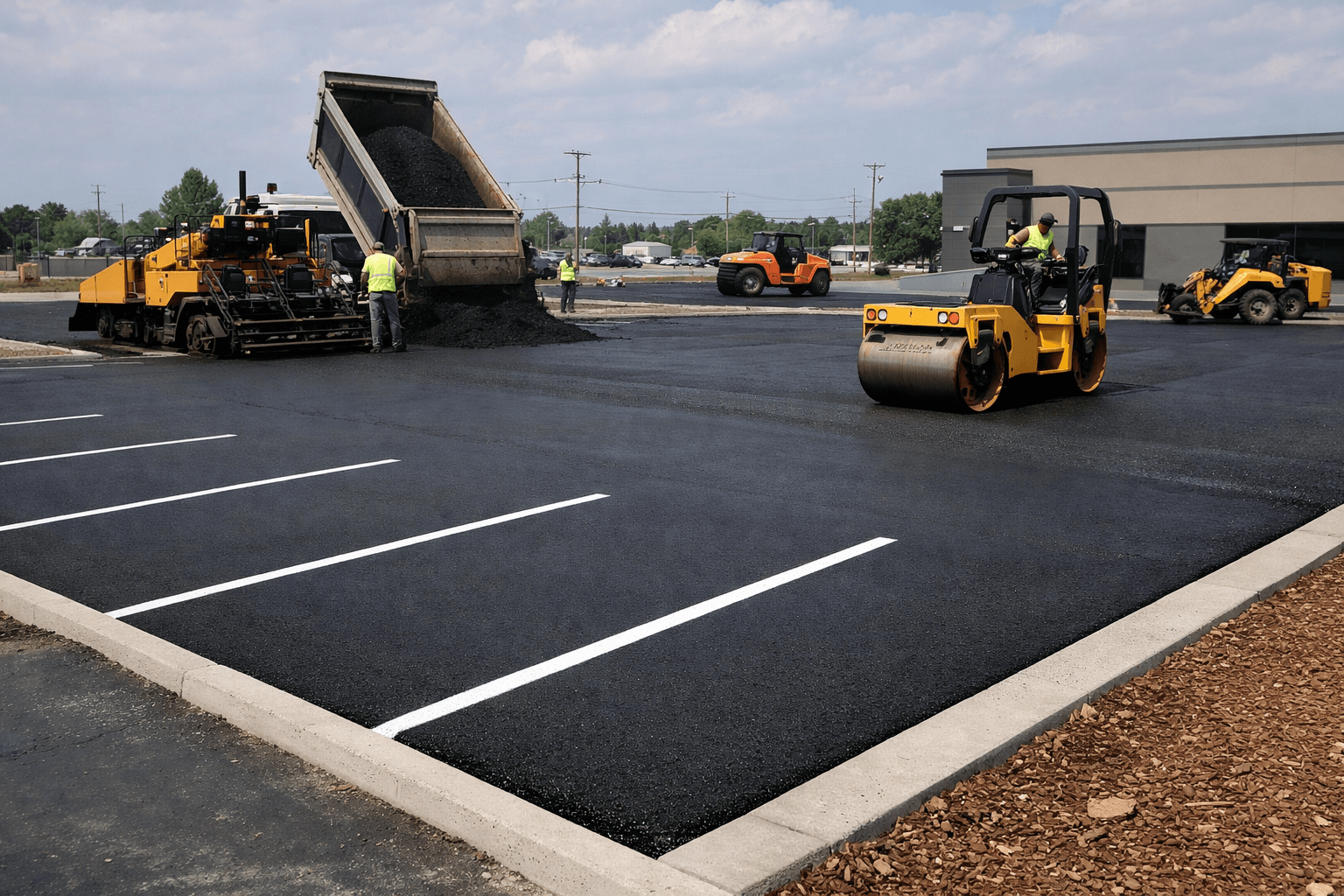
What does commercial asphalt paving in Sandusky, OH actually involve?
Commercial asphalt paving in Sandusky, OH covers the full process of installing or replacing asphalt on parking lots, driveways, access roads, and industrial yards — starting with grading and base prep, through asphalt placement and compaction, to final striping. The right contractor handles every phase in sequence, because skipping steps early shows up as cracking and settling within a few Ohio winters.
How long does a commercial paving project take from first call to finished lot?
Most commercial paving projects in Sandusky run two to five days of active work once the site walk and estimate are done. Larger lots or phased work around an operating business may stretch the schedule, but a competent crew can usually pave a standard commercial parking lot in a single week. Weather and base conditions are the two variables that move that number most.
Why does base preparation matter so much for commercial paving in Ohio?
Ohio's freeze-thaw cycle is hard on asphalt. Water gets into weak base layers, freezes, expands, and pushes the surface up — that's what creates the heaving and cracking you see on neglected lots every spring. A properly graded, compacted aggregate base stops that cycle before it starts. Skimping on base depth to save time is the single most common reason commercial lots fail early in northern Ohio.
The rest of this guide walks through the full commercial paving process as it actually unfolds on a Sandusky job site — what each phase involves, what to watch for, and how to tell if a contractor is doing it right.
The Commercial Paving Process, Step by Step
Site Assessment and Estimate
Everything starts with a site walk — not a phone call. At Swartz Paving, we come out, look at what's there, check drainage patterns, measure the area, and assess the existing base or subgrade before we put a number on paper. That site visit is how we catch problems (buried utilities, soft spots, poor drainage grades) before they become change orders mid-project.
You get a written, itemized estimate. Line by line — base work, asphalt tonnage, drainage corrections if needed, striping. No vague lump-sum quotes that balloon once we're on site. If scope changes, we tell you why before we act.
Demolition and Removal
If there's existing pavement, it gets milled or removed first. On most commercial lots, that means breaking out the old asphalt, loading it, and hauling it off. Reclaimed asphalt (RAP) can often be recycled — which is a cleaner outcome than landfilling it. Once the old surface is gone, the subgrade gets inspected and any soft or unstable areas get addressed before a single stone goes down.
Grading and Base Construction
This is the phase that determines how long your lot lasts. We grade the subgrade to direct water away from the surface — toward drains, swales, or the lot perimeter — then place and compact a crushed aggregate base. Base depth depends on what the lot will carry. A retail parking lot sees different loads than an industrial yard with heavy trucks, and we spec accordingly.
Ohio's freeze-thaw climate means base depth isn't something to negotiate down. A shallow base that seems fine in summer will move in February. We build bases that account for that reality from the start. Our work on Industrial Paving projects — where loads are heaviest — follows the same standard.
Asphalt Placement and Compaction
Once the base is right, asphalt goes down in lifts — typically a binder course first, then a surface course on top. Lift thickness matters: too thin and the mat cools before it compacts properly; too thick and you can't achieve the density the mix needs. We use modern paving equipment sized for commercial work, not residential walk-behind units that can't hold a consistent mat thickness across a wide lot.
Compaction is where a lot of crews cut corners. Under-compacted asphalt is porous, weak, and starts oxidizing faster than it should. We make the right number of passes with a steel-drum roller to hit the density spec — that's what gives you a surface that holds up under daily traffic for years.
For a deeper look at how different asphalt types affect project outcomes, the Types Of Asphalt Paving Explained guide covers what distinguishes binder mixes, surface mixes, and specialty options.
Striping and Final Details
A finished commercial lot needs clear, properly spaced parking stalls, ADA-compliant accessible spaces, fire lanes, directional arrows, and any other required markings. We use thermoplastic or traffic paint depending on the application and stripe to current ADA standards. If your lot has a specific layout requirement, we plan that during the estimate — not as an afterthought on the last day.
New Lot vs. Resurfacing: Which Do You Need?
| Factor | Full New Install | Resurfacing (Overlay) |
|---|---|---|
| Base condition | Built from subgrade up | Requires structurally sound base |
| Existing pavement | Removed and hauled | Stays in place (if stable) |
| Best for | New lots, failed bases, major damage | Surface wear, oxidation, minor cracking |
| Longevity | 20–25+ years with maintenance | 8–15 years added life |
| Drainage corrections | Full regrading possible | Limited adjustment |
- Base condition: new install built from subgrade up — vs. overlay requires a structurally sound existing base
- Existing pavement: full removal for new lots — vs. stays in place if stable for resurfacing
- Best for: failed bases or new construction — vs. surface wear and oxidation
- Longevity: 20–25+ years with maintenance — vs. 8–15 added years from a quality overlay
If your lot has structural base failure — soft spots, alligatoring, or major drainage problems — an overlay won't fix it. You need full-depth work. Our Asphalt Resurfacing page explains how we evaluate which approach fits your situation.
What Makes Paving in Sandusky Different from a Generic Ohio Job?
Erie County's proximity to Lake Erie means freeze-thaw cycles hit harder and more frequently than they do inland. Sandusky sees lake-effect moisture in winter that accelerates water infiltration into pavement that isn't sealed or properly graded. That context shapes how we build — base depths, drainage design, and the timing of sealcoating after new installation all account for the local climate.
We've been doing this work across northern Ohio since 2012. The same crew that walks your site runs the equipment on paving day — no subcontracted strangers showing up with a different set of standards. That continuity matters on a commercial job where the spec we set in the estimate needs to be executed exactly as written.
According to the Federal Highway Administration's asphalt pavement resources, proper compaction and base preparation are the two highest-impact factors in pavement longevity — which aligns exactly with how we prioritize the work. The National Asphalt Pavement Association also provides mix design standards that commercial contractors should be following on every job.
Our full scope of Commercial Paving services covers parking lots, access roads, and site development across Sandusky and the broader northern Ohio region.
What a Good Commercial Paving Estimate Should Include
- Site measurements and area calculations
- Base depth specification and aggregate type
- Asphalt lift thicknesses (binder and surface courses)
- Drainage corrections or grading work itemized separately
- Striping scope — stall count, ADA spaces, fire lanes
- Project timeline and phasing plan if the lot stays open during work
- Written, signed document — not a verbal number
Frequently Asked Questions
Can you pave a commercial lot while the business stays open?
Yes. We phase paving projects around operating businesses regularly. That means working in sections — paving one portion of the lot, letting it cure, then moving to the next — so your customers and employees always have somewhere to park. It takes more coordination, but it's standard practice for us on retail, office, and mixed-use properties throughout Sandusky and the surrounding area.
How soon can a newly paved lot be used after the asphalt is placed?
Light vehicle traffic can typically access fresh asphalt within 24–48 hours in normal temperatures. Hot weather slows the curing process slightly, and heavy truck traffic should wait longer — usually 5–7 days. We'll give you a specific timeline based on the mix, lift thickness, and the forecast at the time of your job. Rushing it with heavy loads causes permanent surface damage.
How do I know if my existing lot needs a full replacement or just resurfacing?
The answer comes from the base, not the surface. If the existing asphalt has widespread alligatoring (a web of interconnected cracks), soft spots underfoot, or drainage that's pooling in the wrong places, the base has failed and an overlay won't hold. If the surface is oxidized, faded, and surface-cracked but the base is solid, resurfacing is a cost-effective option. A site walk tells us which situation you're in — we won't guess off a photo.
Does Sandusky's climate require any special asphalt mix design?
Northern Ohio's freeze-thaw exposure means mix selection matters. We use asphalt mixes suited for Ohio's climate — designed to resist thermal cracking in cold temperatures while staying stable under summer heat loads. Proximity to Lake Erie adds moisture exposure, which reinforces why proper drainage design and post-installation sealcoating are part of the long-term maintenance plan, not optional add-ons.
What's the right maintenance schedule after new commercial asphalt is installed?
New asphalt should cure for at least 90 days before sealcoating. After that initial seal, plan on sealcoating every 2–3 years and crack filling as soon as cracks appear — waiting lets water in. A well-maintained commercial lot in Ohio can last 20 years or more. Neglected pavement that goes unsealed and unrepaired typically deteriorates within 8–10 years to the point where resurfacing or full replacement is the only option.
Ready to move forward on a commercial paving project in Sandusky or anywhere across northern Ohio? Call Swartz Paving at (419) 528-9536 or request a free estimate online. We come to your site, assess what's there, and hand you a written estimate before any work begins. We don't quote off a phone call — and we won't start work until you understand exactly what you're getting.
Ready to Talk Through Your Pavement Project?
Request a free estimate and we’ll follow up with next steps.