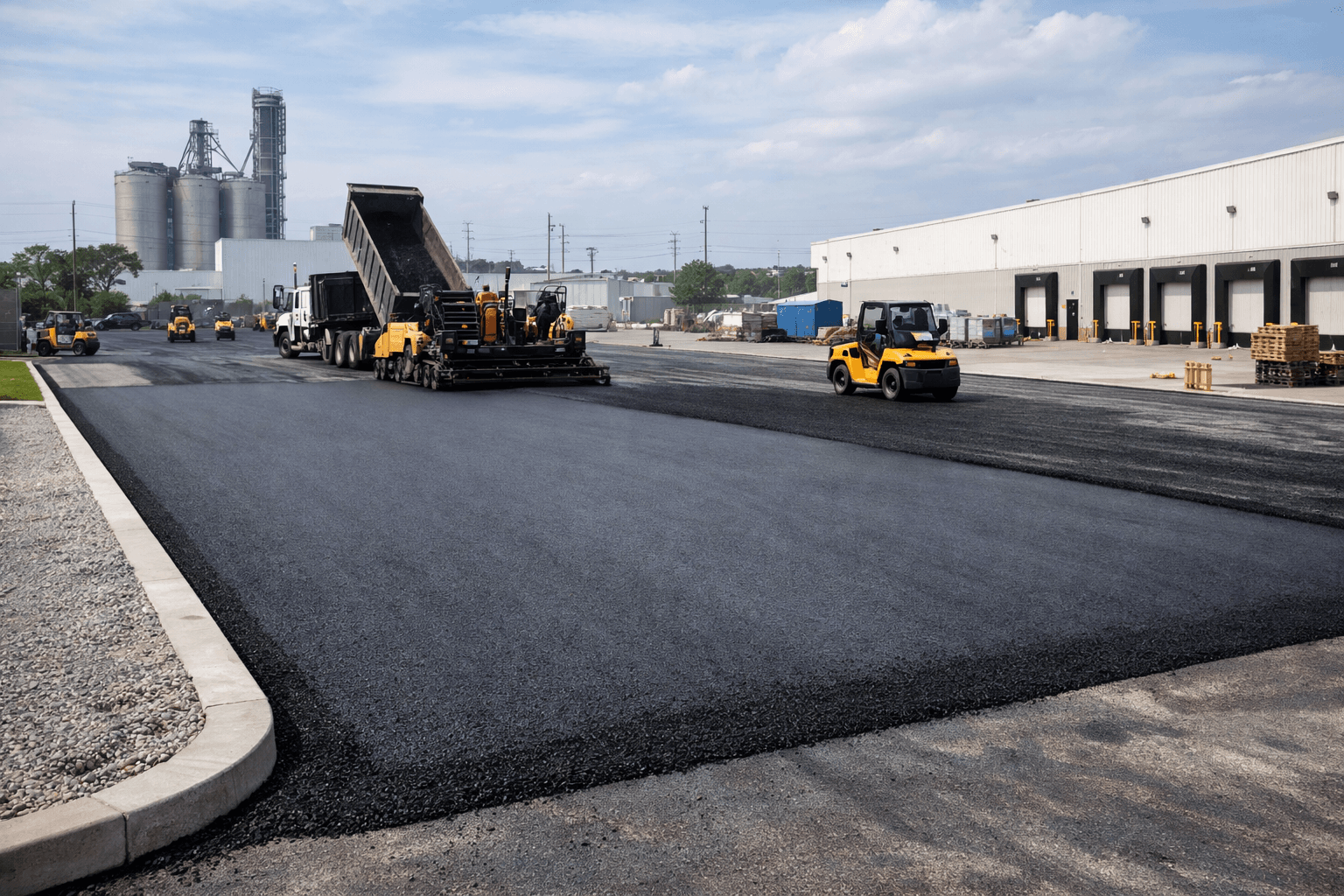
What makes industrial paving different from standard commercial paving?
Industrial paving handles far heavier loads — forklifts, semi-trailers, loaded delivery trucks, and heavy equipment — than a typical parking lot ever sees. That means thicker asphalt lifts, a deeper compacted base, and tighter drainage specs. A surface built to commercial standards will crack and rut quickly under industrial traffic. Getting the base and mix right from the start is what separates a surface that lasts from one you're patching every spring.
How thick does asphalt need to be for a Toledo industrial facility?
Most industrial paving in Toledo calls for a compacted aggregate base of 8 to 12 inches, topped with a binder course and a 2- to 3-inch surface course — sometimes more depending on axle loads and soil conditions. Ohio's freeze-thaw cycles make base depth even more critical here than in milder climates. A site walk and soil assessment should drive final specs; there's no reliable shortcut to measuring what's actually under your lot.
Can paving work be phased so my facility stays operational?
Yes — phased paving is standard practice for operating industrial facilities. A competent contractor sections off the work area, maintains clear traffic lanes for trucks and equipment, and schedules heavy disruption during your lowest-traffic windows. Swartz Paving has been doing exactly this for Ohio industrial clients since 2012, and it's built into how we plan every project from the initial site walk forward.
The rest of this guide walks through what Toledo facility managers need to know before getting estimates — load specs, base requirements, drainage, Ohio climate factors, and what to watch for in a contractor.
If your asphalt isn't built for what rolls across it every day, you'll be repairing it constantly. A loading dock apron that fails under daily semi traffic doesn't just cost money to fix — it costs you downtime, forklift damage claims, and liability exposure. Getting the spec right the first time is cheaper than getting it wrong.
Quick Pre-Estimate Checklist for Industrial Facility Managers
- Know your heaviest vehicle type and axle load (semi, forklift, tandem truck)
- Note areas with standing water or existing drainage problems
- Identify which sections are highest-traffic vs. low-use
- Flag any soft spots, ruts, or areas where pavement has shifted
- Decide which areas need to stay active during construction
- Have a copy of your facility's site plan ready if available
Walk your lot with this list before you call anyone. A contractor who doesn't ask most of these questions during a site visit isn't speccing the job right.
What does the base actually need to look like for industrial asphalt in Ohio?
This is where most paving failures start — not at the surface, but underneath it. Ohio's freeze-thaw cycle (Toledo averages well over 100 freeze-thaw cycles per year, according to NOAA's Cleveland Weather Forecast Office) means water that gets into a weak base will expand, crack the surface from below, and create potholes and heaving that no amount of sealcoating fixes.
For industrial applications, a proper aggregate base typically runs 8 to 12 inches of compacted #304 or #411 limestone. Soft or wet subgrade may require additional geotextile fabric or even lime stabilization before base material goes down. Skipping these steps to save time is exactly how you end up with a failed surface in three years instead of fifteen.
At Swartz Paving, our base work is built specifically around Ohio's climate — not a generic spec copied from somewhere with milder winters. The same crew that walks the site with you does the grading and base compaction. No subcontractors, no handoff, no finger-pointing when something doesn't line up.
What asphalt mix is right for heavy industrial traffic?
Not all asphalt mix is the same. For industrial surfaces, you generally want a polymer-modified binder or a heavier surface mix — typically an ODOT (Ohio Department of Transportation) Type 2 or Type 3 surface course, which uses larger aggregate for added stability and load resistance. A standard Type 1 mix used on residential driveways or light commercial lots won't hold up under repeated forklift or semi traffic.
Lift thickness matters too. A single 2-inch lift is fine for a car lot. Industrial work often calls for a 2.5- to 3-inch surface course over a binder layer, giving you a total asphalt section of 4 to 6 inches above the aggregate base. The Asphalt Pavement Alliance publishes technical guides on mix selection and thickness design if you want to go deeper on the engineering side.
Our Industrial Paving service uses durable mixes and modern equipment sized for commercial and industrial work — not a residential crew that occasionally takes on bigger jobs.
Industrial vs. Standard Commercial Paving: Key Differences
| Factor | Industrial Spec | Standard Commercial |
|---|---|---|
| Base depth | 8–12 inches compacted | 4–6 inches compacted |
| Surface course thickness | 2.5–3 inches | 1.5–2 inches |
| Asphalt mix type | Heavy-duty, polymer-modified | Standard surface mix |
| Drainage design | Engineered slope + catch basins | Basic lot grading |
| Typical lifespan | 15–20+ years with maintenance | 10–15 years |
- Base depth: industrial 8–12 inches vs. commercial 4–6 inches
- Surface thickness: industrial 2.5–3 inches vs. commercial 1.5–2 inches
- Mix type: heavy-duty polymer-modified vs. standard surface mix
- Drainage: engineered slope and catch basins vs. basic lot grading
- Lifespan: 15–20+ years maintained vs. 10–15 years
How does Toledo's climate specifically affect industrial pavement?
Toledo sits in a climate zone where pavement takes a real beating. Cold winters, spring thaws, and wet conditions create constant pressure on any asphalt surface — and industrial lots feel it more because heavy axle loads accelerate any existing weakness the freeze-thaw cycle opens up.
Proper edge construction matters more than most people realize. Industrial lots without reinforced edges shed material fast, especially at dock aprons and entry points where trucks make tight turns. Drainage is equally critical — standing water that freezes beneath the surface is one of the top causes of premature failure in Northwest Ohio.
If your facility is in the Toledo area and you're evaluating your lot's condition, our Toledo OH service page covers what we handle in that market specifically. For broader context on how we approach commercial work across Ohio, our Commercial Paving page lays out the full process.
What should you ask a paving contractor before signing anything?
Get a written, itemized estimate — not a ballpark over the phone. Any contractor who quotes a large industrial job without walking the site is guessing. You want to know the exact base depth they're proposing, the mix spec, the lift thicknesses, how drainage will be handled, and what the phasing plan looks like if your facility stays open.
Ask who runs the equipment. At Swartz Paving, the crew that walks the site with you is the crew that shows up with the paver. No subcontracted labor, no strangers. That matters on industrial jobs where communication between the estimator and the field crew directly affects quality.
Our How To Choose An Asphalt Paving Contractor guide covers the full list of questions to ask before you sign. And if you want to understand how different surface types compare for industrial applications, Types Of Asphalt Paving Explained breaks that down in plain language.
Frequently Asked Questions
How long does industrial asphalt paving typically last in Toledo's climate?
A properly built industrial asphalt surface — with adequate base depth, the right mix, and good drainage — typically lasts 15 to 20 years or more in Ohio's climate before needing full replacement. Regular maintenance like crack filling and sealcoating extends that lifespan. Surfaces built with undersized bases or thin lift thicknesses often fail within 5 to 8 years under heavy traffic and freeze-thaw stress.
Do I need a permit for industrial paving work in Toledo?
Permit requirements in Toledo depend on the scope of work. Full reconstruction and significant grading changes are more likely to require permits than resurfacing or patching. Your contractor should be familiar with local requirements and help you understand what applies to your project. We review permit questions during the estimate process so there are no surprises after work begins.
Can you pave a loading dock apron without shutting down operations?
Yes, in most cases. Loading dock aprons can typically be phased in sections, with one area cured and open before the next section begins. New asphalt needs 24 to 48 hours before light vehicle traffic and 5 to 7 days before heavy truck or forklift use. We build phasing schedules around your operation from the start — not as an afterthought once equipment is on site.
What's the difference between resurfacing and full-depth reclamation for an industrial lot?
Resurfacing (overlay) grinds or mills the top layer and applies new asphalt over the existing base — it works when the base is still structurally sound. Full-depth reclamation tears out the entire section and rebuilds from the subgrade up, which is necessary when the base has failed. For industrial lots, a site assessment determines which is appropriate; resurfacing a lot with a compromised base is money wasted.
How do I know if my existing industrial lot needs full replacement or just repairs?
Look for widespread alligator cracking (interconnected cracks that look like a cracked eggshell), significant rutting in traffic lanes, and soft spots that flex underfoot. These indicate base failure — not a surface problem. Isolated cracks and surface weathering can often be addressed with crack filling, patching, and sealcoating. A site walk with an experienced contractor is the only reliable way to assess which category your lot falls into.
Ready to get a real look at what your Toledo facility's pavement actually needs? Swartz Paving doesn't quote industrial jobs off a phone call. We walk the site, assess the base, and give you a clear written estimate with no pressure. Call us at (419) 528-9536 or reach out through our website to schedule your free estimate — tell us about your project and we'll follow up with next steps.
Ready to Talk Through Your Pavement Project?
Request a free estimate and we’ll follow up with next steps.