When is the best time to resurface an asphalt parking lot in Cincinnati?
The best time to resurface asphalt in Cincinnati is late spring through early fall — roughly May through October — when pavement and air temperatures are consistently above 50°F. Asphalt needs warmth to compact properly and bond to the existing surface. Ohio's freeze-thaw cycles make timing critical: laying fresh asphalt over a cold or wet base shortens its life significantly.
How do I know if my Cincinnati parking lot needs resurfacing or full replacement?
If your asphalt has widespread surface cracking, minor rutting, and drainage that still functions, resurfacing is usually the right move. If you're seeing alligator cracking (a pattern that looks like a cracked eggshell), base failure, or soft spots that sink underfoot, the base is gone and full replacement is the honest answer. Resurfacing over a failed base just delays — and increases — the cost of doing it right.
What does asphalt resurfacing actually involve?
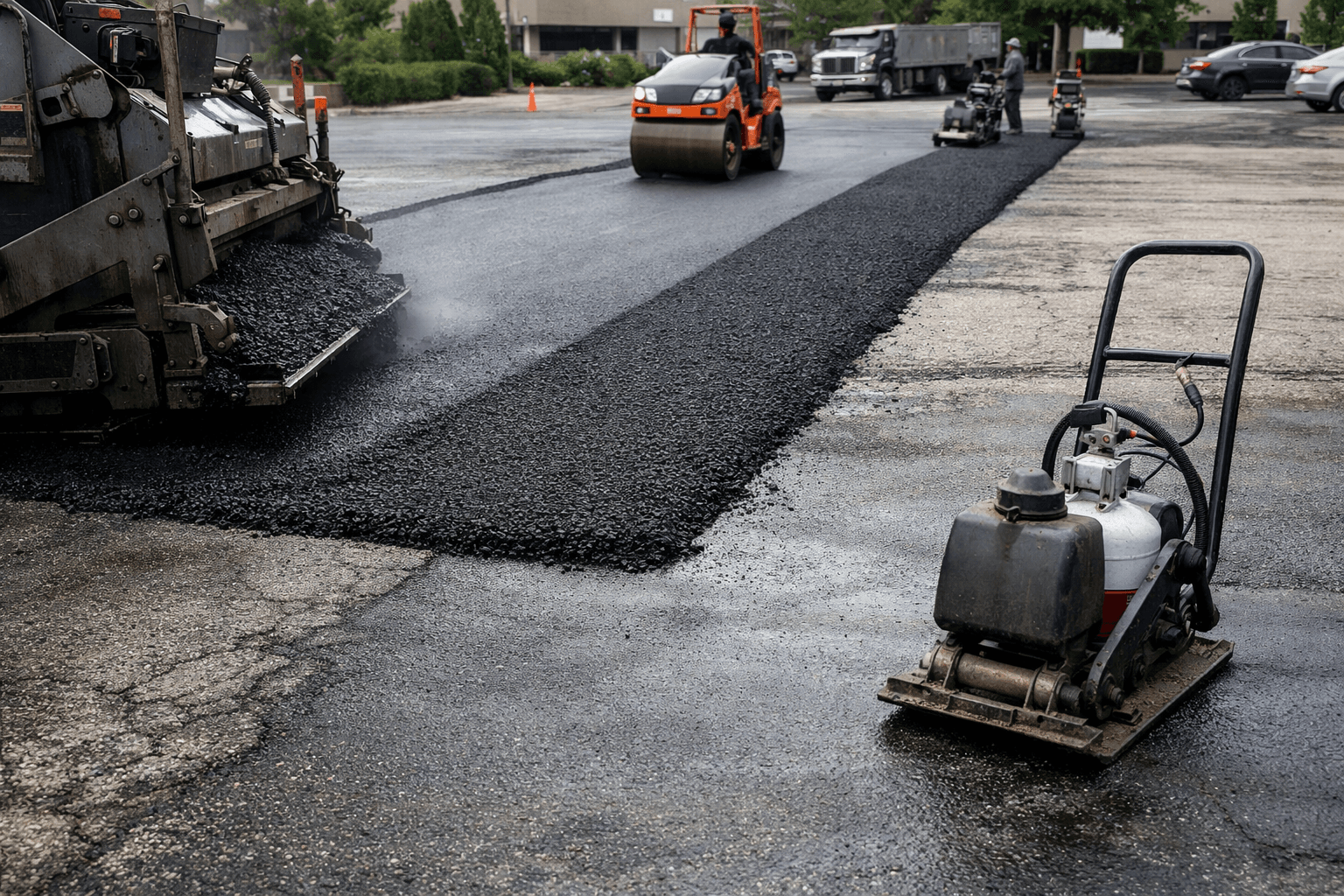
Asphalt resurfacing means milling off or overlaying the existing pavement and applying a fresh layer of hot-mix asphalt, typically 1.5 to 2 inches thick for commercial lots. The existing base stays in place. It restores surface integrity, improves drainage slope, and extends pavement life by 10 to 15 years when the base is structurally sound — at a fraction of the cost of tearing everything out.
If you manage a commercial property in Cincinnati or anywhere across Ohio, asphalt decisions come down to one question: are you spending money on the right fix? This piece walks through the resurfacing vs. full replacement decision, what makes Cincinnati's climate a factor, and how to time a project so it holds up for years — not just months.
Here's the plain truth: a resurfacing project done right on a sound base is one of the best-value pavement investments a property manager can make. A resurfacing project done wrong — on a base that needed full replacement — is money poured into a lot that will fail again inside five years.
Quick Checklist: Is Your Lot a Resurfacing Candidate?
- Surface cracking is shallow — you can't see the base aggregate through the cracks
- No soft spots or areas that flex or sink under vehicle weight
- Drainage still moves water toward the edges or drains — no persistent pooling in the same spots
- Alligator cracking covers less than 25–30% of the total surface area
- The lot is at least 7–10 years old but hasn't been neglected for 20+ years
- Curbing, drainage structures, and base elevation are still functionally correct
If most of those boxes check out, Asphalt Resurfacing is likely your path. If two or more don't, get an honest base assessment before committing to anything.
Resurfacing vs. Full Replacement: The Honest Cincinnati Comparison
This is where a lot of property managers get sold the wrong job — in both directions. Some contractors push full replacement because the margin is higher. Others push resurfacing when the base is already shot, because it's easier to sell. Neither is good for you.
Here's how the two options actually compare for a typical Cincinnati commercial parking lot:
- Base condition: Resurfacing works when the base is structurally intact — full replacement is required when the base has failed or shifted
- Surface damage: Resurfacing handles surface cracking and oxidation well — full replacement is needed for alligator cracking or widespread base failure
- Project scope: Resurfacing keeps the existing base and adds a new wear layer — full replacement means full excavation, new base material, and new asphalt
- Lifespan added: A proper resurfacing adds 10–15 years — a full replacement starts the clock over at 20–25 years
- Business disruption: Resurfacing can often be phased in sections — full replacement usually requires more downtime
- Best use case: Resurfacing suits lots with surface wear but sound structure — full replacement is the right call when the base is compromised
Resurfacing vs. Full Replacement at a Glance
| Factor | Resurfacing (When Base Is Sound) | Full Replacement (When Base Has Failed) |
|---|---|---|
| Base work required | Spot repairs only | Full excavation and rebase |
| New asphalt thickness | 1.5–2" wear layer | Full depth (base + binder + surface) |
| Years of life added | 10–15 years | 20–25 years from scratch |
| Business disruption | Lower — can phase sections | Higher — full closure often needed |
| Risk if done wrong | Low if base is truly sound | High if base problem was missed |
The deeper breakdown of when each option makes sense is covered in our Resurfacing Vs Full Replacement guide — worth reading before you commit to either path.
Why Cincinnati's Climate Makes Timing Matter More Than It Does in Most States
Cincinnati sits in a region that sees genuine freeze-thaw cycling — temperatures that swing from well below freezing in January to 90°F in July. That cycle is what destroys pavement bases over time. Water gets into small cracks, freezes, expands, and turns surface damage into base damage over a few winters.
According to NOAA's Cincinnati weather office, the area averages more than 50 freeze-thaw events per year. That's not a minor variable — it's the reason base preparation matters more in Ohio than in states with milder winters.
For resurfacing specifically, this means:
- Don't resurface in late October or November unless temperatures are holding above 50°F day and night — fresh asphalt that gets hit by a hard freeze before it cures will delaminate
- Don't resurface over standing water or a base that's still saturated from spring thaw — the bond fails
- May through September is the reliable window; early October works if the forecast cooperates
- If you're in the Cincinnati area and scheduling a project, aim to have the crew on-site by late summer at the latest to leave buffer for weather delays
At Swartz Paving, we've been working in Ohio's climate since 2012. Our base work is specifically built for the freeze-thaw conditions that shorten pavement life in this state. That's not a marketing line — it's the difference between a resurfaced lot that holds for 12 years and one that starts cracking again in three.
What Should a Resurfacing Project Include for a Cincinnati Parking Lot?
A properly scoped commercial resurfacing job isn't just laying down hot mix and calling it done. Here's what a complete project should include:
- Base assessment — probing soft spots, checking for base failure before a single ton of asphalt is ordered
- Localized patching — any base failures or deep deterioration get addressed before the overlay goes down
- Edge milling or transitions — grinding down edges where the new layer meets existing pavement or concrete so there's no lip for water to collect
- Hot-mix overlay — 1.5 to 2 inches of commercial-grade asphalt, compacted in lifts with a roller sized for the square footage of your lot
- Drainage verification — confirming the new surface grade moves water toward drains or lot edges, not toward buildings or low spots
- Re-striping — parking stalls, fire lanes, ADA markings, and any directional arrows done fresh on the new surface
We provide itemized written estimates before any work begins — no vague lump sums. You'll know exactly what's included, what's excluded, and why. We don't quote off a phone call. We walk the site.
If you're also evaluating a commercial lot from scratch, the Types Of Asphalt Paving Explained guide breaks down the mix and depth options used in different commercial applications.
Can a Cincinnati Business Stay Open During Resurfacing?
In most cases, yes — and it takes real planning to do it right. Resurfacing in sections lets you keep part of the lot operational while work progresses. We've done this on retail properties, office parks, and industrial facilities across Ohio where full closure wasn't an option.
The keys are: clear communication with tenants or employees in advance, logical sequencing of sections so traffic flow is maintained, and a crew that's experienced enough to move fast and clean. The same team that walks your project with us runs the equipment on your lot — no subcontracted crews showing up with different priorities than what we discussed.
If you're weighing a larger project or comparing contractors, the How To Choose An Asphalt Paving Contractor guide covers the right questions to ask before signing anything.
Frequently Asked Questions
How thick should a resurfacing overlay be for a commercial parking lot in Ohio?
For most commercial parking lots in Ohio, a 1.5 to 2 inch hot-mix asphalt overlay is standard for resurfacing. Lots that see heavy truck traffic or delivery vehicles may benefit from a 2 to 2.5 inch layer. The right thickness depends on current surface condition, traffic loading, and how well the existing base is holding up — a site assessment tells you more than any rule of thumb.
How long does asphalt resurfacing last in Cincinnati's climate?
A properly installed resurfacing overlay on a sound base typically lasts 10 to 15 years in Ohio's climate. Longevity depends heavily on base integrity, drainage quality, and whether maintenance — like sealcoating in Cincinnati — follows on schedule. Lots that get sealcoated every 3 to 5 years and have cracks filled promptly consistently outperform lots that get resurfaced and then ignored.
What's the difference between resurfacing and sealcoating?
Resurfacing adds a new structural layer of asphalt — it rebuilds the wearing surface. Sealcoating applies a thin protective coating over existing asphalt to block UV oxidation and water intrusion. Sealcoating is maintenance; resurfacing is rehabilitation. You sealcoat a lot that's in decent shape. You resurface a lot whose surface has worn through or cracked significantly. According to the Pavement Preservation & Recycling Alliance, sealcoating after resurfacing can extend the new surface life by 30% or more.
Do I need permits to resurface a commercial parking lot in Cincinnati?
In most cases, a straightforward overlay resurfacing project doesn't require a building permit in Cincinnati — but any work that changes drainage patterns, curb grades, or involves ADA accessibility updates may trigger review. We handle permit questions as part of the pre-project walkthrough so you're not caught off-guard. Local requirements can vary, so it's worth confirming with your municipality before the project starts.
What happens if I resurface over a lot that actually needed full replacement?
If the base beneath your lot has failed and you overlay it anyway, the new asphalt will reflect the base damage within one to three years. You'll see cracking, rutting, and soft spots reappear — often worse than before because water now gets trapped between layers. You'll end up spending more than if you'd replaced the base correctly the first time. An honest site assessment before any work begins is the only way to avoid this outcome.
Ready to find out where your Cincinnati lot actually stands? Swartz Paving walks every site before writing a single number on paper. Call us at (419) 528-9536 or request a free estimate and we'll schedule a site walk, assess your base, and give you a clear, itemized written estimate — resurfacing if that's the right answer, replacement if it's not. We don't quote off a phone call, and we don't recommend work you don't need.
Ready to Talk Through Your Pavement Project?
Request a free estimate and we’ll follow up with next steps.